May 30, 2019 12:40 pmPublished by Jack StatesComments Off on U.S. College Graduation Rates
Persistence, Retention, and Attainment of 2011–12 First-Time Beginning Postsecondary Students as of Spring 2017: First Look. This First Look report provides findings from the 2012/17 Beginning Postsecondary Students Longitudinal Study, a national survey of undergraduate students entering postsecondary education for the first time. It looks at a cohort of beginning students over a six-year period of time, examining persistence, retention and attainment (degrees conferred).
The overall graduation rate for first-time, full-time undergraduate students who began seeking a bachelor’s degree at a 4-year degree-granting institution in fall 2012 was 60 percent. That is, by 2017 approximately 60 percent of students had completed a bachelor’s degree. The 6-year graduation rate was 59 percent at public institutions, 74 percent at private nonprofit institutions, and 14 percent at private for-profit institutions. Such low graduation rates are certainly cause for concern for a host of reasons, not the least because the 40% students not graduating have acquired student debt that cannot be offset by the value of having a degree.
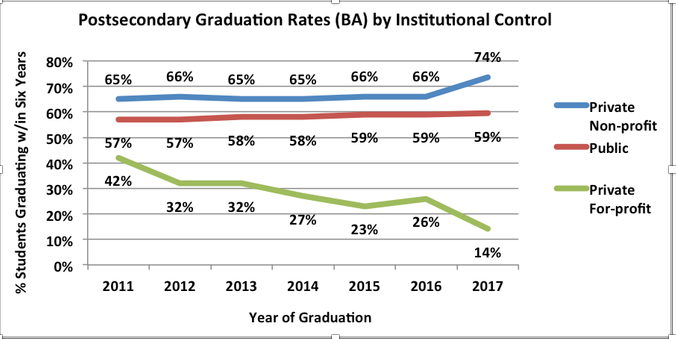
The following data examines postsecondary graduation rates over the past seven years by Institutional control: public, private non-profit, and private for-profit.
Data from The Conditions of Education (2019, 2018, 2017, 2016, 2015, 2014, 2013)
Postsecondary graduation rates in public institutions have stayed virtually the same for seven years, with 57% of students graduating in 2011 and 59% in 2017. Private non-profit institutions remained at 65-66% graduation for the first six years, increasing by 8 percentage points in 2017. Private for-profit institutions fared the worst, decreasing consistently from 42% in 2011 to 14% in 2017.
Citation: Chen, X., Elliott, B.G., Kinney, S.K., Cooney, D., Pretlow, J., Bryan, M., Wu, J., Ramirez, N.A., and Campbell, T. (2019). Persistence, Retention, and Attainment of 2011–12 First-Time Beginning Postsecondary Students as of Spring 2017 (First Look) (NCES 2019-401). U.S. Department of Education. Washington, DC: National Center for Education Statistics.
May 30, 2019 12:30 pmPublished by Jack StatesComments Off on Are current reading practices bridging the reading gap for student with disabilities?
Are Students with Disabilities Accessing the Curriculum? A Meta-analysis of the Reading Achievement Gap between Students with and without Disabilities. A critical goal of federal education policy is improving students with disabilities participation in grade level curriculum. This meta-analysis examines 23 studies for student access to curriculum by assessing the gap in reading achievement between general education peers and students with disabilities (SWD). The study finds that SWDs performed more than three years below peers. The study looks at the implications for changing this pictures and why current policies and practices are not achieving the desired results.
Citation: Gilmour, A. F., Fuchs, D., & Wehby, J. H. (2018). Are students with disabilities accessing the curriculum? A meta-analysis of the reading achievement gap between students with and without disabilities. Exceptional Children. Advanced online publication. doi:10.1177/0014402918795830
May 29, 2019 12:01 pmPublished by Jack StatesComments Off on What practices improve teacher implementation of new practices?
An Investigation of Concurrent Validity of Fidelity of Implementation Measures at Initial Years of Implementation. Much of the effectiveness of newly introduced educational practices is lost within 18 months after introducing the method in the classroom. Understanding why practices with solid research fail is important to improving teacher effectiveness and for improving student performance. Research suggests practices implemented incorrectly are less likely to produce the desired outcomes. Research also finds that treatment fidelity (implementing practices as designed) begins to decline shortly after the new skill has been learned. This paper examines fidelity self-assessment and team-based fidelity measures in the first 4 years of implementation of School-Wide Positive Behavioral Interventions and Supports (SWPBIS). Results show strong positive correlations between fidelity self-assessments and a team-based measure of fidelity at each year of implementation.
Citation: Khoury, C. R., McIntosh, K., & Hoselton, R. (2019). An Investigation of Concurrent Validity of Fidelity of Implementation Measures at Initial Years of Implementation. Remedial and Special Education, 40(1), 25-31.
May 15, 2019 1:43 pmPublished by Jack StatesComments Off on What is the impact of classroom management for ethnically diverse student populations?
Classroom management for ethnic–racial minority students: A meta-analysis of single-case design studies. Demographic changes in the United States support the need to examine the impact of evidence-based classroom management interventions for students from ethic and racially diverse backgrounds. Research consistently shows African-American students receive harsher and exclusionary discipline. Studies also reveal that African American, Latinex, and Native American children are subject to punitive consequences disproportionate to their numbers in the population. This meta-analysis of behavior management strategies includes single-subject designed studies of 838 students from 22 studies for K-12 classrooms. Half of the studies included met the What Works Clearinghouse design standards for the use of single subject design methodology. The study finds the behavior management strategies are highly effective for improving student conduct. Interventions that used an individual or group contingency demonstrated large effects and were the most common behavior management strategies used. The study finds few studies included diverse populations other than African-American students. The authors conclude there exists a need to increase the number of studies of diverse student populations when examining classroom management. They also find a need to improve upon the quality of available studies on the classroom management strategies.
Citation: Long, A. C. J., Miller, F. G., & Upright, J. J. (2019). Classroom management for ethnic–racial minority students: A meta-analysis of single-case design studies. School Psychology, 34(1), 1-13. http://dx.doi.org/10.1037/spq0000305
May 8, 2019 11:23 amPublished by Jack StatesComments Off on Active Student Responding (Wing Institute Original Paper)
Active Student Responding (ASR) is a powerful set of low cost strategies teachers can use to improve student achievement. ASR occurs when a student makes a response by answering questions or responding in a variety of ways that communicates the student’s understanding of the content being taught during the lesson. The more opportunities the student has to respond, the increased likelihood the student is learning. Increasing active responses allows teachers to rapidly assess performance. As opportunities to respond increase so does opportunities for praise and corrective feedback that results in accelerated learning. Attending and being on-task are insufficient ways for teachers to know if learning is occurring. For a teacher to know if a student is actually learning a written, action, or oral response is required. The more opportunities to respond the more quickly students master lessons. ASR strategies are designed to engage all students regardless of class size and ASR avoids the common problem of having only high achievers answer questions while low achievers remain silent, thus escaping detection. Examples of ASR strategies include; guided notes, response slates, response cards, and choral responding.
Citation: States, J., Detrich, R. & Keyworth, R. (2019). Active Student Responding (ASR) Overview.Oakland, CA: The Wing Institute. https://www.winginstitute.org/instructional-delivery-student-respond
April 17, 2019 11:38 amPublished by Jack StatesComments Off on Does the National Board for Professional Teaching Standards Certification (NBPTS) have a positive effect on student outcomes?
What Works Clearinghouse Intervention Report: National Board for Professional Teaching Standards Certification. NBPTS was established in 1987 to foster “high and rigorous standards for what accomplished teachers should know and be able to do” (NBPTS mission statement). As a voluntary national system, NBPTS certifies that a teacher has taught in the field and meets certification requirements for best practices for instruction and pedagogy. The standards reflect five core propositions: (1) effective teachers are committed to students and their learning, (2) effective teachers know the subjects they teach and how to teach those subjects to students, (3) effective teachers manage and monitor student learning, (4) effective teachers think systematically about their practice and learn from experience, and (5) effective teachers are members of learning communities.
The process requires teachers to pay a fee and can take from 3 months to several years to complete. School districts have come to view the process as a way to improve student achievement, allocating scarce resources in the form of performance compensation to encourage teachers who acquire certification. The What Works Clearinghouse review found NBPTS-certified teachers had mixed effects on mathematics achievement and no discernible effects on English language arts achievement for students in grades 3 through 8.
Citation: Mathematica Policy Research (2018). What Works Clearinghouse Intervention Report: National Board for Professional Teaching Standards Certification. Washington, DC: U.S. Department of Education, National Center for Education Statistics, National Assessment of Educational Progress (NAEP). Retrieved from https://ies.ed.gov/ncee/wwc/Docs/InterventionReports/wwc_nbpts_021318.pdf.
April 17, 2019 10:18 amPublished by Jack StatesComments Off on How does attending a charter school impact success in college?
Do Charter Middle Schools Improve Students’ College Outcomes? This study examines the impact of Charter schools on college enrollment. The National Center for Education Evaluation and Regional Assistance (NCEE) used college enrollment and completion data for students who (more than a decade ago) entered lotteries to be admitted to 31 charter middle schools across the United States. College outcomes were compared for 1,723 randomly selected “lottery winners” and 1,150 randomly selected “lottery losers”. The results show that admission to a charter middle school did not affect college outcomes. Additionally, the study finds no consistent relationship between the impact a charter middle school achievement and the school’s impact on college outcomes
Citation: Place, K., & Gleason, P. Do Charter Middle Schools Improve Students’ College Outcomes? (Study Highlights) (No. 61bd53574633412b9136328cb4e143ef). Mathematica Policy Research.
April 16, 2019 11:17 amPublished by Jack StatesComments Off on Performance Feedback Overview (Wing Institute Original Paper)
Performance feedback is a practice used to improve performance. Principals give feedback to teachers to clarify expectations and to provide information for increasing administrative, instructional, behavior management, and personal competency skills. More than seven meta-analyses conducted since 1980 support feedback as one of the most powerful tools for improving performance. To deliver useful feedback, principals need current and accurate information on student performance and a teacher’s instructional skills. Research finds that principals depend on unreliable sources of data such as “walk-throughs,” brief informal observations that provide snapshots of classroom activities but are not designed for performance improvement. Principals should replace traditional walk-throughs with more effective feedback practices, such as coaching, that are better suited to improving specific teaching skills. For the best results, feedback must meet these four conditions: (1) It is objective, reliable, measurable, and specific; (2) it provides information about what was done well, what needs improvement, and how to improve; (3) it is delivered frequently and immediately following performance; and (4) it is about performance rather than personal characteristics.
April 15, 2019 11:57 amPublished by Jack StatesComments Off on How can educators more effectively use web-based resources?
Proceed With Caution: Using Web-Based Resources for Instructing Students With and at Risk for EBD. This article examines issues relating to the use of websites popular with educators. Today educators often rely on social media platforms such as Pinterest and Teachers Pay Teachers for information for solving problems encountered in the classroom. These sites can offer teachers helpful information, but also come with potential risks that educators need to consider when utilizing such resources. This article offers guidelines for maximizing the usefulness of such sites and for avoiding many of the pitfall educators may face. The authors suggest educators first identify and learn the critical elements of effective practices from trustworthy sources and then use sites such as Pinterest and Teachers Pay Teachers to facilitate implementation.
Citation: Beahm, L. A., Cook, B. G., & Cook, L. (2019). Proceed With Caution: Using Web-Based Resources for Instructing Students With and at Risk for EBD. Beyond Behavior, 28(1), 13-20.
April 12, 2019 2:43 pmPublished by Jack StatesComments Off on Chronic Student Absenteeism: A Significant and Overlooked Obstacle to Student Achievement
Decades of research document the significant negative impacts of student absenteeism on academic achievement, emotional development, graduation, health, and long-term success (Gottfried, 2015). Yet, until just a few years ago, the U.S. K–12 education system was virtually unaware that it had a chronic student absenteeism problem. Prior to that time, chronic absenteeism was never tracked by school systems, let alone addressed. A recent analysis of the data revealed that a significant number of students (one in seven) were chronically absent, defined as missing 10% of school days (Balfanz & Brynes, 2012). And that was the threshold number. Many students identified as chronically absent missed more than 10%. The corresponding negative impacts worsen with every additional day of school missed.
This overview looks at the best available evidence on chronic student absenteeism in the context of (1) the scale of the problem at all levels of the education system: national, state, school, and grade; (2) the impact on student academic performance, graduation, health, and financial impact on school districts; (3) impact multipliers that exacerbate chronic absenteeism, such as poverty, student mobility, homelessness, and disciplinary suspensions; and (4) interventions utilizing a public health tiered model for different levels of action depending on need, a performance feedback system to track and modify the results of each intervention, and coordination of resources across a wide range of education stakeholders.
Citation: Keyworth, R., Detrich, R. & States, J. (2019). Overview of Chronic Student Absenteeism: A Significant and Overlooked Obstacle to Student Achievement. Oakland, CA: The Wing Institute. https://www.winginstitute.org/perform-levels-student.