
School Psychology Review’s focus on Culturally Responsive Practices and Instruction
October 16, 2026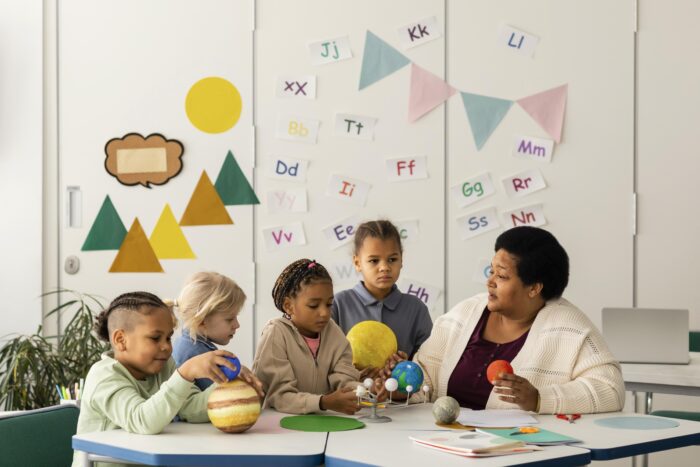
A teacher and four students sit at a table discussing and handling a model of the solar system. Image by Magnific
School Psychology Review, the flagship journal of the National Association of School Psychologists, has just published a special issue on the topic of Understanding, Measuring, and Promoting Culturally Responsive Instruction and Discipline.
The introductory article (free access), Understanding, Measuring, and Promoting Culturally Responsive Instruction and Discipline: The Responsive Practices to Outcomes Model, 1briefly reviews the other articles in the special issue. Key elements of this article are:
- Description of the problem
- Systemic racial inequalities in schools persist and lead to disparities in educational outcomes.
- Defining the main aspects of Culturally Responsive Practices (CRPs)
- aligning ways of knowing and learning at school with students’ home cultures2
- addressing the structural inequities that decrease student’s connection with their schools
- exploring cultural practices of learning in your community
- thoughtfully working varied learning approaches into your instructional techniques
- increasing teacher recognition of students’ home lives and cultures as rich sources of knowledge which can be connected or related to school learning3
- Introduction of a promising program model
- The Double Check framework provides coaching and feedback to support teachers implementing CRPs.4
This will also be the topic of a forthcoming Wing Institute newsletter, which will summarize recent research articles from this and other journals on this topic. The newsletter will also include practical steps and tips to guide teachers and school site teams in effectively implementing CRPs in their local context.
- Herman, K. C., Reinke, W. M., Bradshaw, C. P., & Debnam, K. (2026). Understanding, measuring, and promoting culturally responsive instruction and discipline: The Responsive Practices to Outcomes Model. School Psychology Review, 55(5), 605-620. ↩︎
- Gutiérrez, K. D., & Rogoff, B. (2003). Cultural ways of learning: Individual traits or repertoires of practice. Educational researcher, 32(5), 19-25. ↩︎
- González, N., Moll, L. C., & Amanti, C. (Eds.). (2006). Funds of knowledge: Theorizing practices in households, communities, and classrooms. Routledge. ↩︎
- Hershfeldt, P. A., Sechrest, R., Pell, K. L., Rosenberg, M. S., Bradshaw, C. P., & Leaf, P. J. (2009). Double-Check: A framework of cultural responsiveness applied to classroom behavior. Teaching Exceptional Children Plus, 6(2), 2-18. ↩︎
Wing Institute news section
Authored by: Emma Hendricks Date Published: October 16th, 2026
Proudly powered by WordPress